
Start with what one paid attempt covers
Two vendors can quote similar rates while charging for different things. Before comparing prices, establish whether the unit is a candidate, an assessment attempt, an individual test, a credit or a subscription allowance. Ask how the unit is consumed and whether it expires.
Build your estimate around the hiring workflow you intend to run. A first-round screening test and a second-round assessment may require different commercial arrangements. Do not assume that a single credit covers every assessment a candidate might take.
- How is an attempt counted if the candidate does not finish?
- Are retries or rescheduled tests charged separately?
- Does the quoted allowance include every section and format you need?
- Is there a minimum purchase, validity period or setup charge?
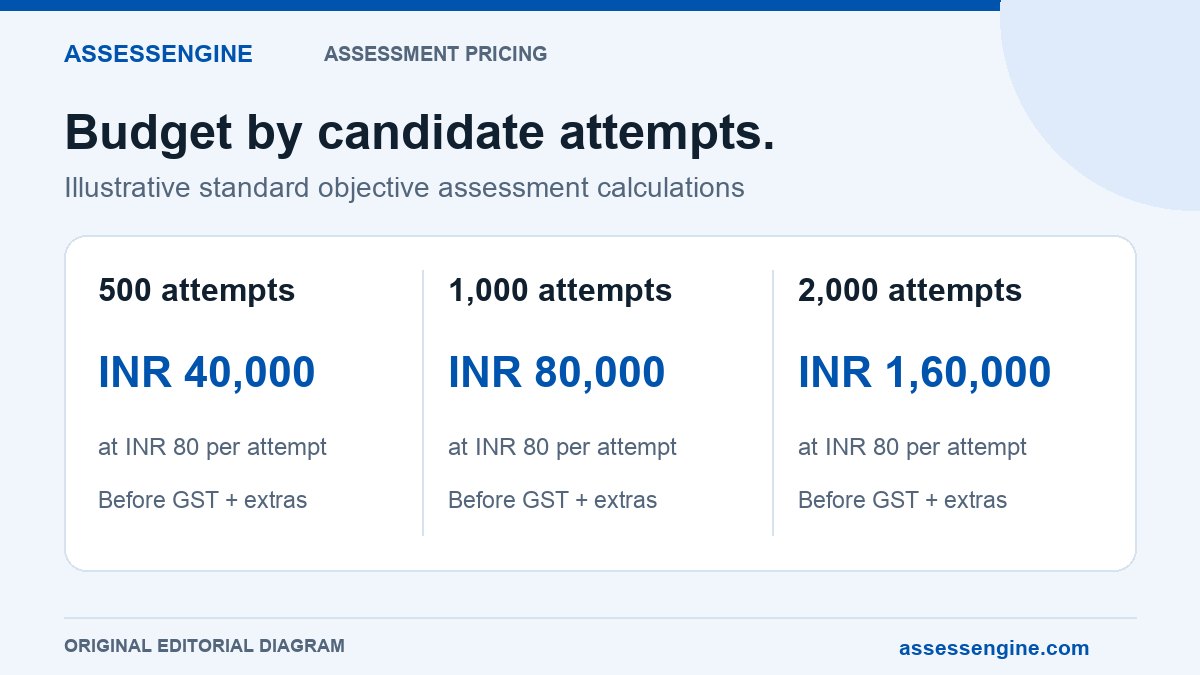
Worked example: 500, 1,000 and 2,000 attempts
The following arithmetic uses AssessEngine’s published standard objective rate of ₹80 per credit before GST. It assumes one paid candidate attempt per credit and excludes proctoring, other formats and any separately quoted services. These are planning examples, not a binding quotation or a claim about volume discounts.
- 500 standard objective attempts × ₹80 = ₹40,000 before GST and extras.
- 1,000 standard objective attempts × ₹80 = ₹80,000 before GST and extras.
- 2,000 standard objective attempts × ₹80 = ₹1,60,000 before GST and extras.
- If 1,000 people are invited, confirm the charging rules before treating 1,000 invitations as 1,000 billable attempts.
Separate the base assessment from optional requirements
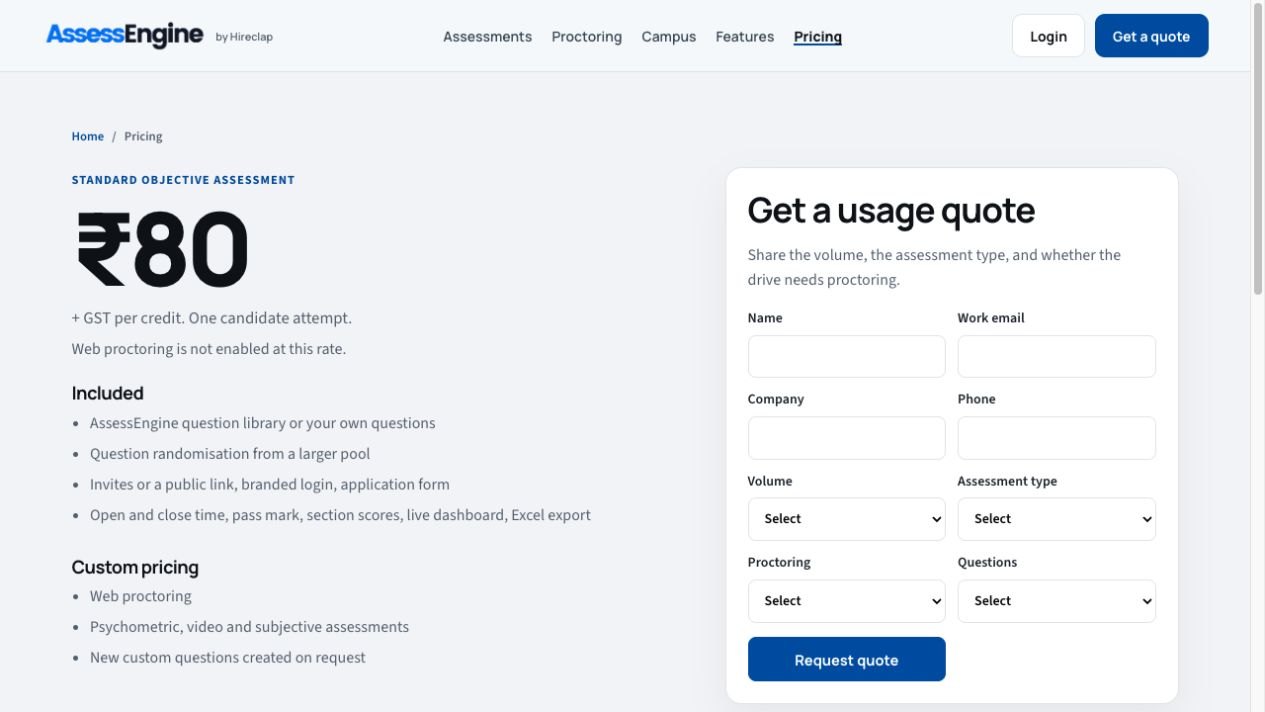
AssessEngine’s pricing page lists question-library or employer-supplied questions, candidate access, section scores and exports among its standard objective features. It states that web proctoring is not enabled at the ₹80 rate. Proctoring, psychometric and video assessments, and newly created custom questions use custom pricing.
Ask for a written scope that matches your actual drive. If your process needs several assessment formats, get the commercial treatment of the combined workflow confirmed before payment. Use the current pricing page and final approved quotation rather than an old article as the purchase reference.
Use the same brief for every vendor
Send each shortlisted provider one assessment brief. Otherwise a low headline price can appear attractive simply because it leaves out the support, reporting or assessment configuration your team needs.
A useful comparison records both the quoted amount and the answer to each requirement. Mark unconfirmed items explicitly rather than assuming they are included.
- Expected candidate attempts, roles, test windows and assessment duration.
- Question source, required sections and who will review custom questions.
- Proctoring requirements and the evidence available for recruiter review.
- Report fields, exports and any required connection to existing systems.
- Support arrangements, retries, delivery responsibilities, taxes and payment terms.
Reduce avoidable spend without weakening the test
Review questions and instructions before launch so candidates do not need unnecessary repeat attempts. Pilot the full journey and make sure the report contains what the hiring manager needs. A cheap test that must be rerun is not a useful saving.
After the drive, track invitations, starts, completed attempts, usable reports and interview progression separately. These measures help you understand where budget was consumed. They do not establish assessment quality or return on investment on their own.
What to include in your AssessEngine quote request
Share the role, expected attempt volume, assessment formats, question source, hiring dates and whether proctoring is required. Ask the team to walk through a sample report and confirm the exact scope and amount in the quotation.
For a larger campus drive, include college coordination and support expectations in the discussion. Agreeing on delivery responsibilities before launch makes the commercial comparison more useful than comparing a per-credit number alone.
Common questions
How much does an online assessment cost for 1,000 candidates?
At AssessEngine’s currently published standard objective rate, 1,000 candidate attempts would be ₹80,000 before GST and extras. This assumes one paid attempt per candidate. Confirm proctoring, other formats, retry rules and the final price in a quotation.
Is web proctoring included at ₹80 per credit?
No. AssessEngine’s current pricing page states that web proctoring is not enabled at that rate. Proctoring is quoted separately as part of the assessment setup.
Is a pay-per-attempt plan always cheaper than a subscription?
No. Compare the same expected usage, included features, validity periods and extra charges. The suitable pricing model depends on your assessment pattern and the quoted terms.
Can we calculate the budget from the number of invitations?
Use invitations as a planning input, then confirm how billable attempts are counted. Starts, completions, retries and no-shows may be treated differently under different commercial terms.
Sources and further reading
Explore AssessEngine
Have a correction or a question? Contact the AssessEngine team and include this article's title.