
Confirm what the report represents
Start with the role, assessment version and the candidate’s attempt details. Results are easier to interpret when you know which sections were included, how marks were awarded and what the assessment was intended to measure.
Check whether the attempt is complete and whether any questions require reviewer scoring. A score with unanswered or unreviewed components may not be comparable with a fully evaluated result. Confirm the platform’s handling of these cases before applying a shortlist rule.
- Candidate and attempt identifier.
- Role, assessment version and test window.
- Completed sections and any outstanding reviewer-scored responses.
- Maximum marks, negative marking and qualifying rules used for that assessment.
Read section scores before relying on the total
The total score can conceal different strengths. Break it down by section and consider the evidence each section supplies for the role. A numerical reasoning score and a written response are different forms of evidence and may need different review methods.
Avoid comparing raw section marks when their maximum marks differ. Convert them to a common representation where appropriate, while remembering that equal percentages across different sections do not necessarily mean equal difficulty or proficiency.
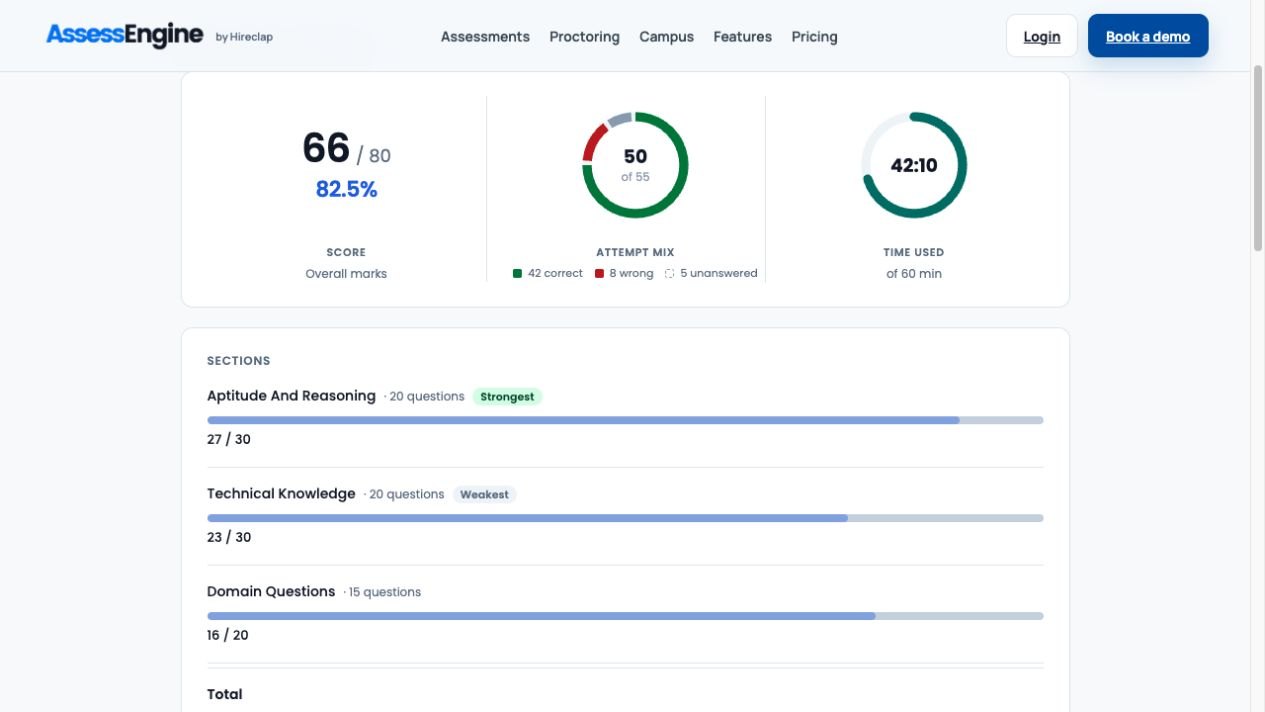
In the public sample report pictured below, the illustrative total is 66 out of 80 (82.5%). The attempt mix is 42 correct, 8 wrong and 5 unanswered, with 42 minutes 10 seconds used out of 60 minutes. Section results are 27/30 for Aptitude and Reasoning, 23/30 for Technical Knowledge and 16/20 for Domain Questions. Use each section in context; the total alone does not explain the pattern. These are demonstration scores, not customer outcomes.
Worked example: the same total, different section profiles
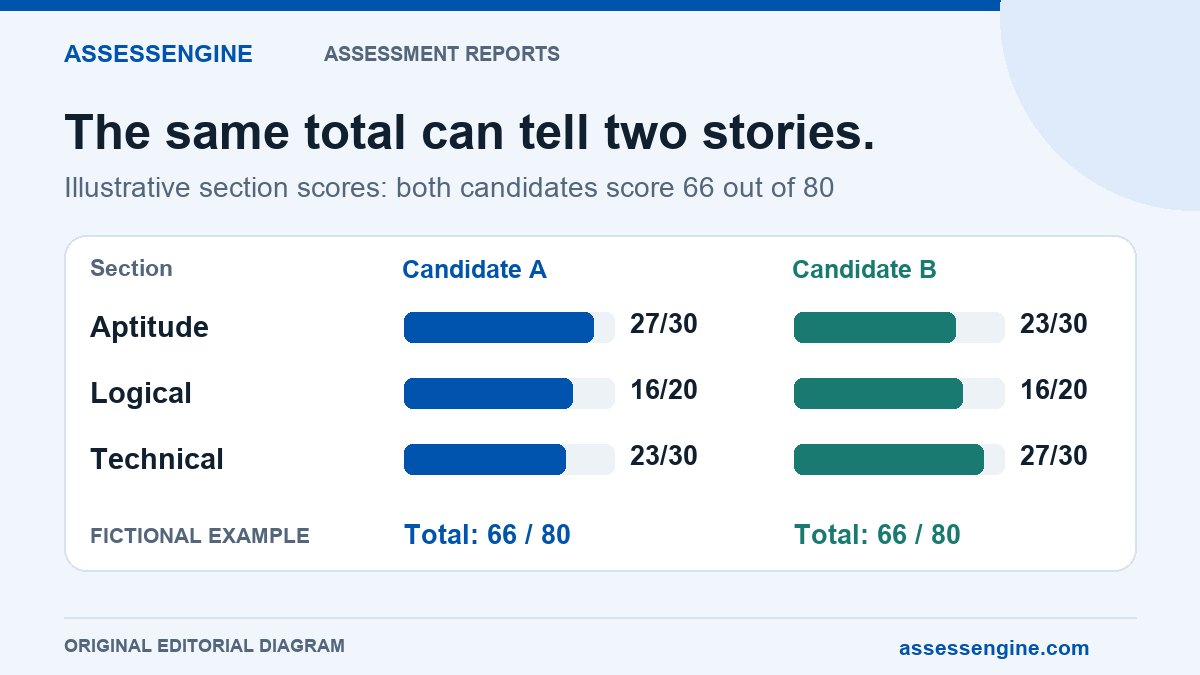
Consider a fictional 80-mark assessment with aptitude worth 30, logical reasoning worth 20 and technical knowledge worth 30. The following numbers illustrate report reading only; they are not candidate data, validated cut-offs or a recommended hiring rule.
- Candidate A: aptitude 27/30, logical reasoning 16/20, technical knowledge 23/30. Total: 66/80.
- Candidate B: aptitude 23/30, logical reasoning 16/20, technical knowledge 27/30. Total: 66/80.
- Both totals are 82.5%, but the aptitude and technical results differ.
- The follow-up interview should explore the evidence relevant to the role instead of treating the identical totals as identical profiles.
Check whether candidates took comparable assessments
Before ranking a large cohort, confirm the assessment versions, scoring settings and delivery conditions. A percentage from one test is not automatically equivalent to a percentage from another test with different content or difficulty.
Question randomisation can change what candidates see. Ask the provider how the question pool is designed and how interpretation should work for your setup. Randomisation alone does not establish that every version is equivalent.
If a report includes a percentile, ask which comparison group it uses and how it was calculated. Do not describe an ordinary percentage as a percentile: they communicate different information.
Keep integrity evidence distinct from capability scores
A score describes performance on the assessed material under the configured scoring rules. Activity records describe events observed during the attempt. Review both, but do not substitute one for the other.
In AssessEngine, recruiters can review section results and assessment activity where enabled. Activity labels prompt a human review; they do not replace the hiring team’s judgment. Use a documented exception process when a report needs clarification.
Turn the report into interview questions
Choose a small number of role-relevant areas to explore rather than reading every score back to the candidate. Ask for a worked explanation, an example or a practical demonstration that adds evidence beyond the test result.
For the fictional profiles above, a hiring manager might ask Candidate A to explain a technical approach and Candidate B to reason through a numerical business problem. These are examples of follow-up questions, not recommendations to hire one candidate over the other.
- Ask what reasoning led to an answer, rather than only whether it was correct.
- Use consistent core questions for candidates applying to the same role.
- Record the interview evidence separately from the test score.
- Document the reason for any exception to the agreed shortlist process.
Check the report and export before a large drive
AssessEngine’s features page describes section scores, detailed responses and Excel exports, along with online or downloadable candidate reports. Before launch, inspect a completed example and check that your hiring team can understand and use the fields it receives.
Agree on the report owner, export format and next-stage communication before results arrive. This keeps the assessment from becoming a spreadsheet that nobody knows how to interpret and makes the demo a useful test of your real workflow.
Common questions
What should recruiters check first in an assessment report?
Confirm the candidate, attempt status, assessment version, sections and scoring rules. Then review section results and any responses still awaiting evaluation.
Is a percentage the same as a percentile?
No. A percentage expresses marks earned relative to available marks. A percentile describes relative standing in a defined comparison group; ask how that group and calculation were established.
Can two candidates with the same total score have different strengths?
Yes. Their marks may be distributed differently across sections. The fictional example in this guide shows identical totals with different aptitude and technical profiles.
Does an assessment report replace an interview?
No. Use the report to identify job-relevant areas to examine alongside structured interviews and other evidence. Your hiring team remains responsible for the decision.
Sources and further reading
Explore AssessEngine
Have a correction or a question? Contact the AssessEngine team and include this article's title.