
What does “technical assessment” actually mean?
Technical assessment is a broad label. It can refer to a knowledge questionnaire, a written case, a live technical interview, a coding problem or a project task. Ask what the candidate actually does and what evidence the reviewer receives.
The distinction matters when a recruitment brief simply says “test technical skills.” A questionnaire about programming concepts is different from asking someone to implement a working feature. Neither description alone tells you whether the assessment is appropriate for a specific job.
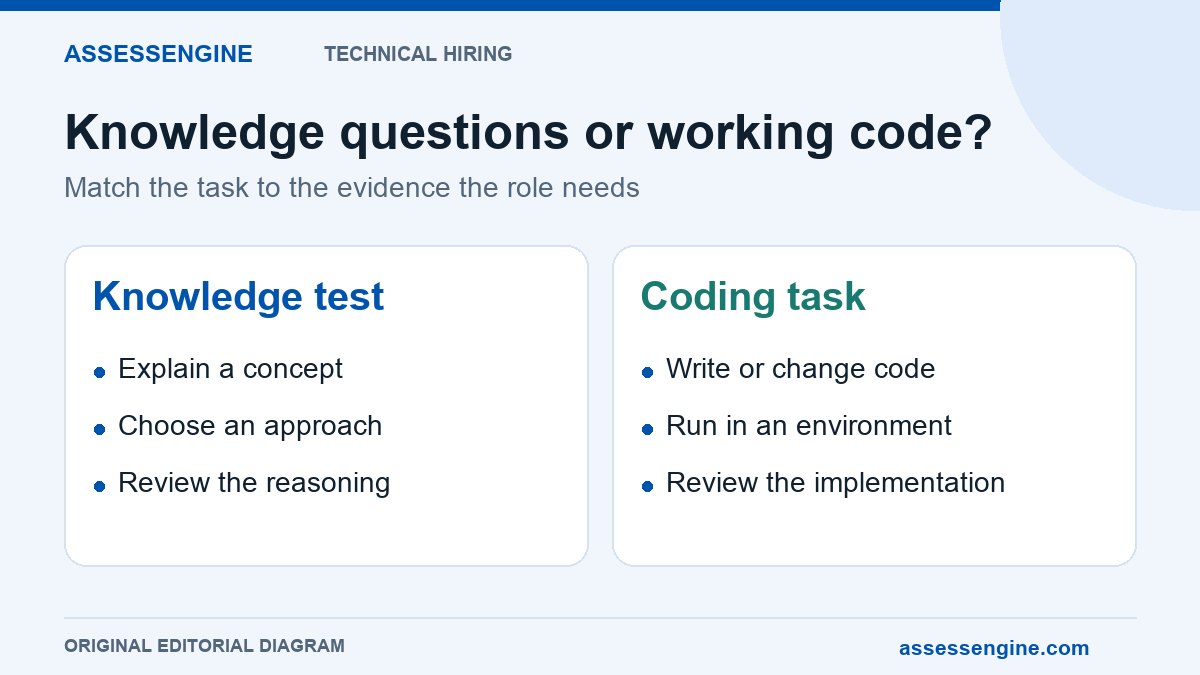
What a technical knowledge test can examine
Knowledge questions can cover relevant concepts, terminology, rules and the reasoning used to select an approach. Depending on the format, candidates may choose an answer or explain their response in writing. Question quality and scoring still need review.
For an engineering role, the relevant knowledge might concern the engineering discipline rather than programming. For an IT support role, it might concern troubleshooting concepts. Avoid treating “technical” as a synonym for “software developer” when writing the brief.
- Ask which concepts a new hire must understand for the role.
- Review sample questions with someone who performs or supervises the work.
- Check whether the scoring distinguishes a correct selection from a useful explanation.
- Identify practical abilities that still need another assessment stage.
What a hands-on coding test can examine
A coding task asks the candidate to produce or change code. A project task may involve several files or a partial application. The assessment environment and review criteria determine what evidence the result supplies.
HackerRank’s official documentation, for example, distinguishes coding questions from multi-file project questions and describes implementation and debugging tasks. That illustrates why recruiters should ask about the actual task and environment instead of comparing platforms using a broad “technical assessment” label.
- Supported languages, versions and development tools.
- Whether the task involves a single function, debugging or a larger project.
- How submitted code is executed and evaluated.
- What reviewers can inspect beyond a pass/fail or total score.
- The instructions about permitted tools and external resources.
Illustrative example: knowledge and implementation are different questions
Suppose a junior developer role requires basic database work. A knowledge question might ask the candidate to explain the purpose of a join. A practical task might ask them to write and run a query against a supplied dataset, then explain the result.
These are original illustrative task ideas, not validated hiring items or a statement that AssessEngine provides a database execution environment. They show why a recruiter should map the task to the evidence needed and verify the delivery tools separately.
A strong explanation does not establish that working code was produced, while a passing execution result may still leave questions about the approach. A follow-up discussion can add context, using the same core review criteria for candidates applying to the role.
Choose the assessment sequence for the role
A team may use a focused knowledge screen before a practical interview, or move directly to a job-relevant practical task where that suits the role and candidate pool. There is no single sequence appropriate for every hiring program.
Consider the candidate’s time, the evidence already available and the review capacity of the hiring team. Adding stages that repeat the same information increases administration without necessarily answering another hiring question.
- List the job tasks the selection process must examine.
- Map each task to the proposed assessment or interview stage.
- Remove duplicated checks unless they have a clear purpose.
- Pilot the candidate instructions and reviewer report before wider use.
Questions to ask during the platform demo
Request a demonstration using a representative question or task, including what the candidate sees and what the reviewer receives. Ask which answers are automatically scored and which need a human reviewer.
AssessEngine’s published pages describe technical knowledge screening, configurable sections, written responses and recruiter reports. A coding execution environment should be demonstrated and confirmed separately rather than inferred from those features. Use the product demo to establish the scope for your actual requirement.
Use the results to focus the next conversation
Review the evidence from each stage against the relevant job requirement. Do not treat two identical percentage scores from different task formats as equivalent evidence. Confirm the task content and scoring context before comparing candidates.
Use the report to prepare specific follow-up questions: ask for an explanation, a worked approach or a practical demonstration where a capability remains unclear. Keep the final hiring decision grounded in the complete set of job-relevant evidence your team has gathered.
Common questions
Is every technical assessment a coding test?
No. Technical assessment can include knowledge questions, written cases, interviews, coding tasks or projects. Confirm the actual candidate task and delivery environment.
Can multiple-choice questions prove hands-on coding ability?
They can supply evidence about the material they ask about, but they do not demonstrate that a candidate wrote and executed code. Use an appropriate practical task when that evidence is required.
Should every engineering candidate take a coding test?
Choose from the actual role requirements. Some engineering roles require programming; others require different technical knowledge and practical tasks.
What should we confirm before buying a coding assessment?
Confirm the supported task types, execution environment, languages, scoring approach, reviewer evidence, candidate instructions and quoted scope. Do not infer these capabilities from a generic technical-testing description.
Sources and further reading
Explore AssessEngine
Have a correction or a question? Contact the AssessEngine team and include this article's title.