
What is an aptitude test used for in recruitment?
An aptitude assessment gives recruiters a consistent way to ask candidates to work through selected reasoning tasks. Its usefulness depends on what the questions measure, how well they fit the job and how the results are interpreted. A test label alone does not establish that a particular assessment predicts performance in your role.
Begin with the work a new hire will actually do. If the role involves reading instructions and checking figures, those activities can inform the assessment brief. If the role requires specialist knowledge or practical work, plan to collect that evidence separately rather than expecting a general reasoning score to cover everything.
Choose the sections from the work, not from a generic template
Discuss the proposed sections with the hiring manager. A graduate sales role, an operations role and an engineering role may need different evidence. Start with a focused brief and remove questions whose purpose nobody can explain.
- Numerical reasoning: interpreting quantities, rates or a small table of figures when that reasoning is relevant to the role.
- Verbal reasoning: understanding a passage, following instructions or distinguishing a supported conclusion from an unsupported one.
- Logical reasoning: applying stated rules, identifying relationships or working through a sequence.
- Role knowledge: add a separate section where the job requires knowledge that a general aptitude question does not establish.
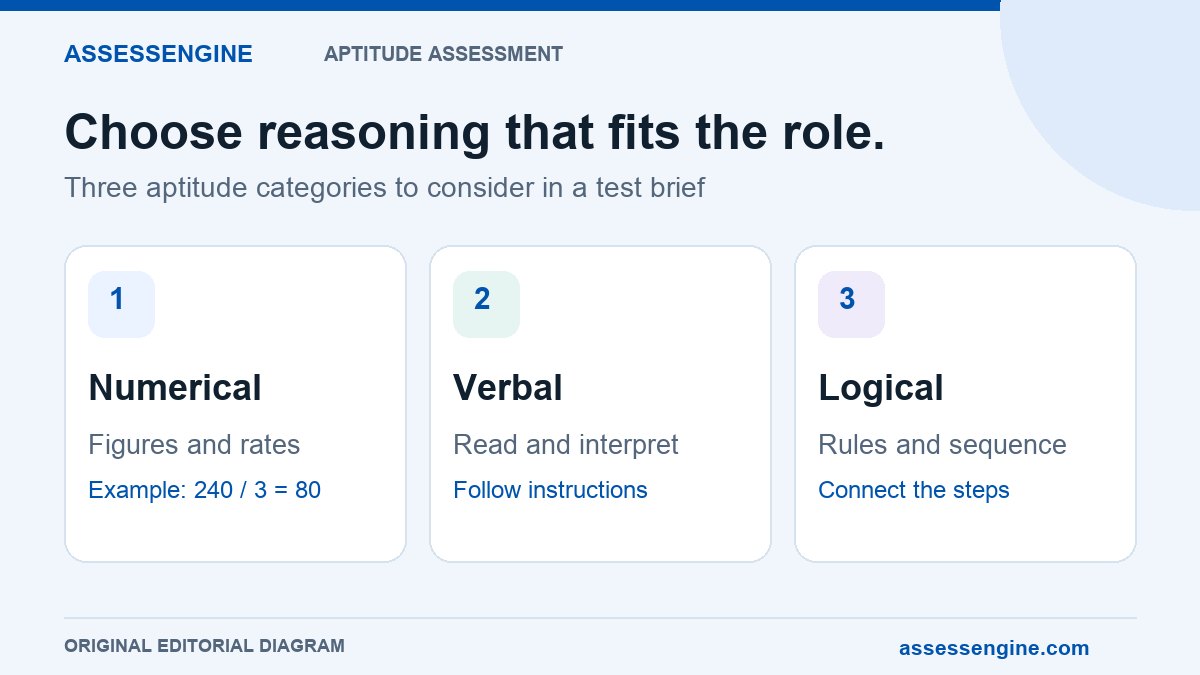
Three illustrative aptitude question ideas
These original examples explain question formats. They are not validated selection items, a ready-made recruitment paper or questions taken from the AssessEngine library. Review any assessment questions properly before using them for hiring.
- Numerical example: a team checks 240 records in three hours at a constant rate. How many records does it check per hour? The answer is 80. A follow-up can ask how the candidate calculated it.
- Verbal example: an instruction says, “Send the summary after the supervisor approves it.” Does the instruction permit sending the summary before approval? No; the stated order requires approval first.
- Logical example: task B must follow task A, and task C must follow task B. Which task must finish before C can begin? B must finish first; the stated sequence also places A earlier.
Write a test brief before choosing the questions
A brief helps recruitment, the hiring manager and the assessment provider agree on the same requirement. Include candidate level, relevant language expectations and the reasoning tasks to assess. Avoid testing unfamiliar terminology unless that terminology is part of the job requirement.
Timing and scoring should be explicit. Decide whether unanswered questions, negative marking or section thresholds apply, and make the candidate instructions match the configuration. Do not adopt a cut-off simply because another employer uses it.
- Role and graduate or experience level.
- What each section is intended to establish.
- Question source, review owner and scoring rules.
- Device requirements, accessibility arrangements and candidate support.
- How the results will inform the interview stage.
Pilot for clarity and delivery before the first candidate cohort
Ask colleagues to take the assessment using only the instructions a candidate receives. Look for ambiguous wording, incorrect answer keys, missing information and unexpected time pressure. Check the registration and report as well as the questions.
A small delivery pilot can reveal practical problems. It does not establish scientific validity, reliability or a fair threshold by itself. Ask the provider what evidence is available for the intended use and involve appropriate assessment expertise when evaluating those claims.
Read aptitude scores in context
Review section results rather than treating the total as a complete picture of the candidate. Check that results being compared come from an appropriate common assessment setup. Use the findings to prepare job-relevant interview questions and record the evidence gathered at each stage.
AssessEngine offers browser-based aptitude assessments and configurable test sections, with recruiter reports and result exports. Review the actual question setup and a sample report during the demo, then confirm the scope and price for your hiring program.
Common questions
What aptitude sections should recruiters include?
Choose sections from job requirements. Numerical, verbal and logical reasoning are common categories, but not every role needs all three or the same balance.
What is a good passing score for an aptitude test?
There is no universal passing score. Review the assessment content, intended use and supporting evidence before agreeing on a role-specific shortlist process.
Can employers use their own aptitude questions?
AssessEngine’s published features include employer-supplied questions and Excel upload. Review the questions, answer keys and scoring before delivery.
Is an aptitude test enough to select a candidate?
Use aptitude results as one source of evidence. Interviews and job-relevant practical or knowledge checks may be needed for capabilities the assessment does not establish.
Sources and further reading
Explore AssessEngine
Have a correction or a question? Contact the AssessEngine team and include this article's title.