
What is a psychometric assessment for hiring?
Psychometric assessment is a broad term rather than one particular test. Instruments may examine abilities, personality-related attributes or other individual differences. Ask what a specific assessment measures, how it is scored and what evidence supports the proposed interpretation.
This guide focuses on work style, situational judgment and work values in recruitment. It does not assume that every questionnaire using the psychometric label has the same scientific support. CIPD guidance on selection recommends checking validity, reliability and appropriate use, and using test results as part of a wider selection process.
Is an aptitude test different from a psychometric test?
These terms are not opposites. An aptitude test can itself be a psychometric instrument when designed and supported appropriately. In a recruitment discussion, the useful distinction is the attribute being examined and the evidence the candidate supplies.
An aptitude question might ask someone to solve a numerical problem. A work-style questionnaire may ask about their usual way of working. A situational-judgment question presents a workplace situation and possible responses. The formats and intended interpretations differ, so a combined total should not be assumed meaningful.
Work style, situational judgment and work values
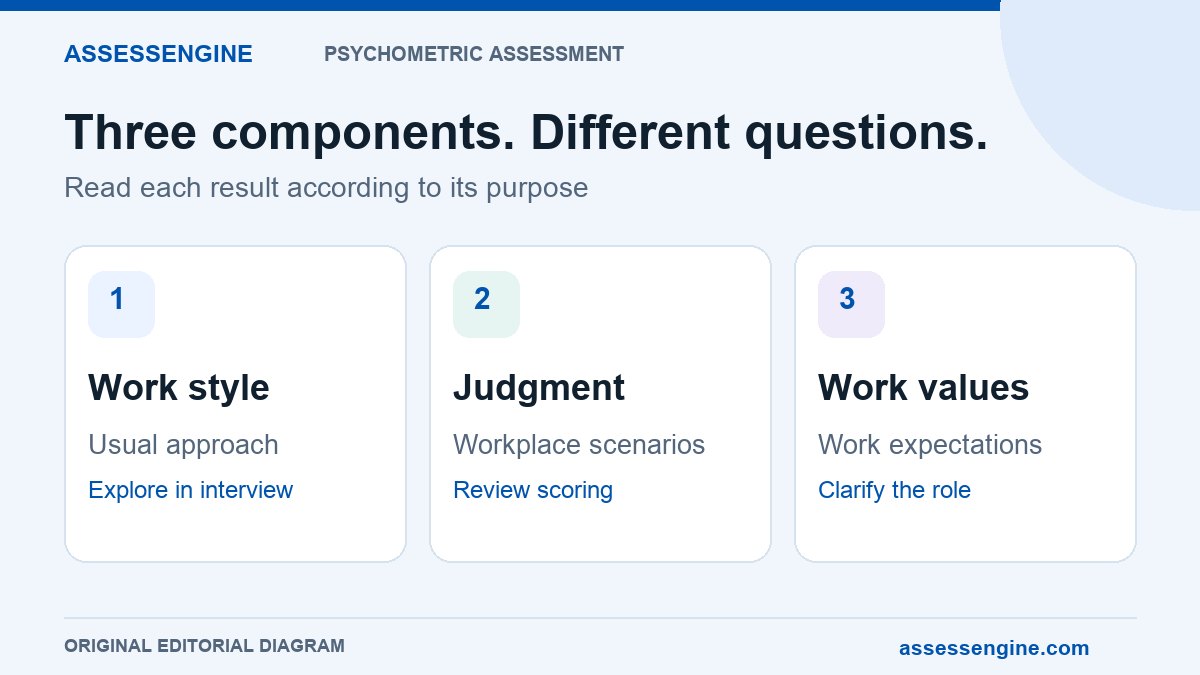
AssessEngine’s psychometric offering describes these three components. Each needs its own explanation in the report and a clear purpose in the interview process. The definitions below explain that product scope, not interchangeable measures of an overall “good personality.”
- Work style: how the person describes their usual approach to work. Use the profile to identify questions for discussion, rather than treating a preferred style as automatically better.
- Situational judgment: responses to specified workplace scenarios. Review the scenario, scoring rationale and relevance to the role when interpreting the score.
- Work values: what the person says they want from work. Use the results to clarify expectations about the actual role and environment, rather than assuming a profile predicts how long someone will stay.
Where can this fit in campus recruitment?
Graduate candidates may have limited full-time work history. A structured discussion of workplace scenarios or preferences can give the interviewer a starting point, but it should not be mistaken for observed performance in the job.
Map each proposed component to a question the hiring process still needs to answer. If aptitude or technical knowledge is already assessed, do not describe a work-style questionnaire as another measurement of the same capability. Keep a clear purpose for every stage and avoid duplicating questions simply to lengthen the assessment.
Turn a profile into interview questions: three examples
The following are original, fictional examples of follow-up questions. They are not AssessEngine report labels, scored assessment items or profiles of real candidates. Their purpose is to explore context and behavior rather than confirm a label.
- If a profile suggests a preference for clear direction, ask: “Tell me about a time priorities changed and you did not have complete instructions. What did you do first?” Follow up on the action and result.
- If workplace scenarios concern a disagreement with a colleague, ask: “Describe a disagreement in a group project. How did you understand the other person’s concern and decide what to do?” Ask the same core question consistently for the role.
- If a candidate values development opportunities, explain what training the role actually provides and ask: “Which skills are you hoping to develop, and what support would you expect?” Use the conversation to clarify expectations.
Should a psychometric assessment have a passing score?
Do not assume that every component needs a cut-off. AssessEngine’s product page states that work-style and work-values profiles do not have pass marks, while situational-judgment questions can have one. That distinction should remain visible when the recruitment team discusses results.
A system’s ability to configure a threshold does not establish that the threshold is appropriate. Review the scoring rationale and intended use with suitable assessment expertise. Avoid converting a preference profile into an unexplained pass/fail decision or treating resemblance to the existing team as sufficient evidence of suitability.
Questions to ask before choosing a psychometric assessment
Ask for the instrument’s documentation and a sample interpretation walkthrough. The evidence should relate to the intended use; a general claim about psychometric testing does not establish the quality of one particular questionnaire. Clarify any training needed for the people interpreting results.
- What does each component measure, and which decisions is it intended to inform?
- What evidence supports reliability and validity for the proposed use?
- Does the interpretation use a comparison group? If so, who is in that group and is it relevant?
- Which scores are criterion-based, which describe preferences and what should not be inferred?
- What will candidates be told about duration, requirements, feedback and adjustments?
- Who may access the results, and how are retention and deletion handled?
What does AssessEngine’s offering include?
AssessEngine describes an entry-level and campus set covering work style, situational judgment and work values, usually taking about 25–35 minutes. Confirm the selected components, language, timing and interpretation process for your actual hiring program.
The product page states that its questions use original workplace wording and are not a licensed Big Five, Myers-Briggs or DISC questionnaire. Do not infer licensing, accreditation or proven predictive accuracy from those names or from the word psychometric. Request the evidence and product documentation needed for your specific use.
Bring the role requirements and planned interview process to a demo. Ask how a recruiter should read the report, what an interviewer can reasonably follow up on and which claims the assessment does not establish. Confirm the scope and price in a quotation.
Common questions
What is a psychometric assessment used for in hiring?
Depending on the instrument, it can provide structured information about abilities, work preferences or responses to workplace situations. Check the specific purpose and evidence, and use the results with other job-relevant assessment methods.
Is an aptitude test a psychometric test?
It can be. Psychometric is a broader term, and appropriately designed aptitude instruments may fall within it. Compare the attributes measured and the interpretation of each instrument rather than treating the terms as opposites.
Does AssessEngine use licensed Big Five, Myers-Briggs or DISC questionnaires?
AssessEngine’s product page states that its work-style questions use original workplace wording and are not a licensed Big Five, Myers-Briggs or DISC questionnaire.
Can work-style or work-values results have a pass mark?
AssessEngine’s product page says work style and work values do not have pass marks. Its situational-judgment component can have a pass mark; the suitability of scoring and thresholds still needs review for the intended use.
How long does the AssessEngine campus set take?
The published product page describes a usual duration of about 25–35 minutes for work style, situational judgment and work values together. Confirm the exact setup before inviting candidates.
Should a psychometric report replace an interview?
No. Use it to identify appropriate follow-up questions alongside other job-relevant evidence. The hiring team remains responsible for interpreting the evidence and making the decision.
Sources and further reading
Explore AssessEngine
Have a correction or a question? Contact the AssessEngine team and include this article's title.